


Cost Advantages Propel SiC Optical Waveguide Market Toward Exponential Growth, Targeting 70 Million Unit Shipments by 2030
Silicon Carbide (SiC) optical waveguide technology is rapidly becoming a key driver for the mass commercialization of AR glasses. Market analysis indicates that with the successful launch of multiple products utilizing this technology—such as Meta's Orion, Qiuguo's Wigain Omnision, and Chaomang's Coray Air2—the technology has passed initial validation from lab to market. An industry chain is taking shape, attracting increased investment and strategic positioning from both upstream and downstream enterprises.
Dual Drivers of Performance and Cost are Expanding Market Potential
The rise of SiC optical waveguides is attributed to their compelling price-to-performance advantages, which are difficult to replicate with other technologies. On the performance side, their high refractive index and low loss characteristics directly enhance the core user experience of AR products—offering a wider field of view and sharper imagery—laying the foundation for product premiumization.
On the cost side, which ultimately determines market scale, a clear path toward cost reduction is emerging. While industry firm Mudeweina previously projected costs could fall to around 650 RMB, Guangnasiwei CTO Shi Rui presented a more striking figure under mass production assumptions: "At an annual production volume of one million units, the cost of SiC etched optical waveguides can be controlled at approximately 425.5 RMB." This price point significantly lowers the barrier for adoption by device manufacturers, creating potential for AR hardware targeting a broader consumer base.
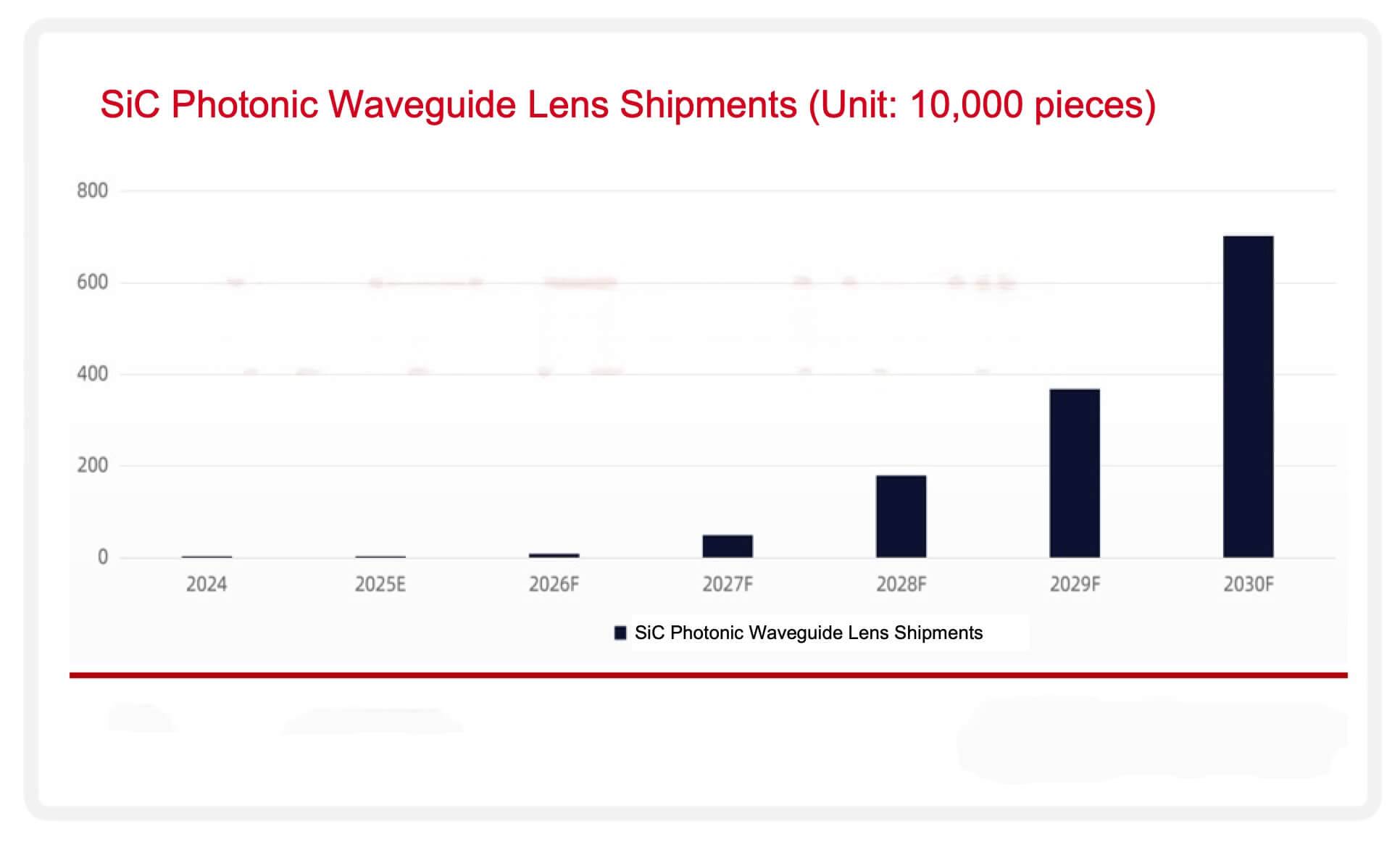
Inflection Point for Scalability Reached, 70 Million Units to Fuel Ecosystem Growth
Considering the combined trends in technology advancement and cost reduction, the market consensus is that SiC optical waveguides have reached an inflection point for large-scale adoption. This view is supported by authoritative data from the "2025 AI + AR Glasses Optical Display Research White Paper," which forecasts that shipments of SiC waveguide lenses will approach 500,000 units by 2027 and surge to 70 million units by 2030. This exponential growth trajectory indicates that SiC waveguides are poised to become a mainstream optical solution for AR in the coming years and will fundamentally activate the upstream supply chain.
Consequently, demand for key materials like SiC substrates is expected to rise in tandem, fostering the development of a vast industrial ecosystem encompassing materials, equipment, design, and manufacturing. The competitive landscape will then likely evolve beyond pure technological competition into a comprehensive contest involving supply chain stability, cost control capabilities, and mass production efficiency.