


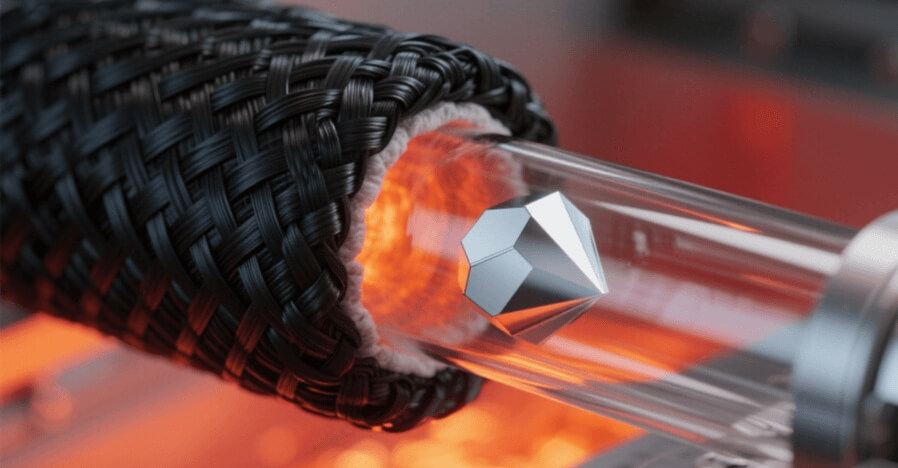
High-performance carbon fiber insulation materials in the field of silicon carbide crystal growth
Silicon carbide crystal growth is a core upstream process in the manufacturing of next-generation semiconductor chips (widely used in new energy vehicles, rail transit, smart grids, and 5G communications). The process is extremely demanding (temperature >2000°C, requiring high vacuum or inert atmospheres), placing the highest demands on thermal field materials.
Core Challenges and Material Advantages
In the PVT method, a core challenge is to establish an accurate, stable, and controllable temperature gradient and thermal field environment. Silicon carbide powder sublimates in the high-temperature zone (~2300°C) and then recrystallizes and grows at the seed crystal region with slightly lower temperatures. Any minor fluctuations or inhomogeneities in the thermal field can lead to crystal defects (such as polymorphs, microtubes) or even growth failure.
Limitations of traditional materials (primarily isostatic graphite):
Isotropic thermal conductivity: Graphite has excellent thermal conductivity in all directions, which is unfavorable for creating sharp axial temperature gradients.
High-temperature volatilization and contamination: At temperatures above 2000°C in a vacuum environment, graphite continuously volatilizes (sublimates), producing carbon vapor. This not only contaminates the crystals but also causes the insulation layer to gradually thin and degrade in performance, requiring frequent replacement.
Mechanical strength degradation: After multiple high-temperature thermal cycles, graphite components become brittle, lose strength, and are prone to cracking and damage.
High thermal inertia: Graphite has a high specific heat capacity, resulting in slow heating and cooling processes, which reduces production efficiency and flexibility in process adjustments.
Advantages of high-performance carbon fiber composite insulation materials:
Designable anisotropic thermal conductivity: This is its core advantage. Through layered design, radial insulation and axial heat conduction can be achieved, or customized solutions can be provided to perfectly meet the specific temperature gradient requirements of the PVT method in different directions.
Extremely low high-temperature volatility: Using ultra-high-purity carbon fiber and advanced interface treatment technology, its mass loss rate at high temperatures is significantly lower than that of traditional graphite, resulting in a longer service life and reduced pollution.
Excellent high-temperature mechanical properties: High strength, good toughness, and exceptional thermal shock resistance, capable of withstanding repeated rapid cooling and heating without cracking.
Lightweight: With a density significantly lower than graphite, it is easy to install and maintain.
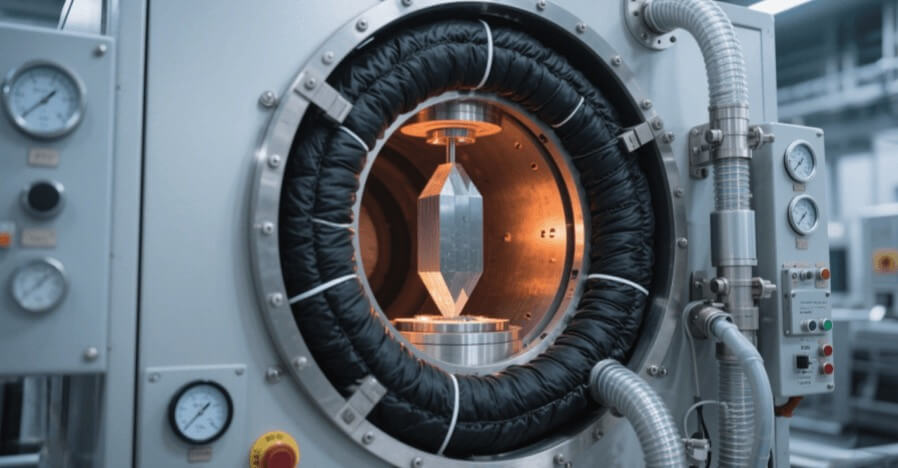
In PVT furnaces, insulation materials primarily form the insulation stack, surrounding the heating elements and crucibles. Their function is to minimize heat loss and precisely shape the thermal field distribution.
1. Anisotropic insulation stack
This represents the most revolutionary application of carbon fiber composite materials.
Specific application:
The material is designed as a layered structure with extremely low radial thermal conductivity and relatively high axial thermal conductivity.
Radial insulation: Effectively prevents heat radiation and conduction to the furnace walls, significantly reducing energy consumption and protecting the furnace body's cooling jacket.
Axial heat conduction: Allows heat to be transmitted more effectively and controllably along a specific direction (from the lower heat source to the upper seed crystals), facilitating the formation and maintenance of the steep axial temperature gradient required for growth. This gradient is the core driving force for gas-phase transport and crystal growth.
Value delivered by high-performance carbon fiber composite insulation materials:
Precise control of the growth interface: Achieves a flatter, more stable growth interface, which is critical for producing low-defect, high-quality large-size single crystals.
Improved crystal quality: Reduces thermal field fluctuations and asymmetry, effectively suppressing the formation of defects such as polymorphic inclusions.
Energy saving and reduced consumption: Excellent thermal insulation performance reduces energy consumption by approximately 20%-30%, directly lowering production costs.
2. High-performance insulation screens/shields
Within the thermal field, specific shields or screens are required to fine-tune local heat flow.
Specific applications:
At critical locations on the top, sides, or bottom of the crucible, use heat shields or flow guides made of carbon fiber composite materials.
These components can precisely shield or redirect thermal radiation, preventing excessive heat buildup or loss in certain areas, thereby optimizing temperature distribution within the crucible and at the growth interface.
Value provided by high-performance carbon fiber composite insulation materials:
Addressing the "edge effect": Improve growth conditions at crystal edges, ensuring more uniform growth rates across the crystal diameter range and enhancing ingot utilization.
Suppress parasitic nucleation: By locally cooling non-seed crystal regions (such as crucible walls), unnecessary spontaneous nucleation is prevented, ensuring the purity of single crystal growth.
3. Lightweight support and connection components
Various support components are required within the thermal field to secure heating elements, crucibles, and insulation layers.
Specific applications:
This material is used to manufacture bolts, gaskets, support rods, and other connecting and structural components.
These components must withstand high temperatures and loads while ensuring their thermal conductivity and thermal expansion behavior match those of surrounding graphite components to prevent thermal stress damage
Value provided by high-performance carbon fiber composite insulation materials:
Excellent mechanical reliability: High strength and toughness ensure structural integrity after multiple thermal cycles, preventing component failure and costly system breakdowns.
Low thermal expansion matching: Its coefficient of thermal expansion (CTE) can be designed to be similar to graphite, enabling coordinated deformation during heating and cooling processes to reduce stress.
Reduced heat loss: Compared to metal connectors (such as molybdenum bolts), it offers superior insulation and prevents the formation of local "cold spots" or thermal short circuits.
It directly enables the production of larger-sized (8 inches and above), lower defect density, and higher uniformity silicon carbide single crystal substrates, thereby reducing the manufacturing costs of downstream devices and enhancing their performance, driving the rapid development of the wide bandgap semiconductor industry. This is not merely a material replacement but a transformative enhancement and innovation of the entire crystal growth process.